Polyester Cationic Dyed Yarns
Polyester Cationic Dyed Yarn is produced from CDP chip that consists
of dimethyl isophthalate with polar radical SO3Na.The dye-absorption
property of fiber is greatly improved. It is thus easy to be dyed with improved dye-absorption rate and moisture-absorption
property. Cationic Dyed Yarns have features like light and
water color fastness, vivid color and luster, good deep dyeing
property, high dye-absorption rate, good stability in high temperature
dyeing solutions and high stability of dyes when the PH value changes in dyeing
bath.
The special properties of a cationic dyed polyester yarn are
–
- Cost effective dyeing procedure using intensive cationic dyes and low dyeing temperatures from 980 to 1200C
- Excellent bath exhaustion
- High dyeing speed
- Cationic yarns can also be colored using disperse dyes up to 1200C
- Ideal mixing element for wool or elasthane fibres (Lycra) that cannot be dyed at high temperatures
- Offers good combination possibilities with other fibers – mixing element for dual-tone and multi-color effects
- Shows high luminosity when using cationic dyes
- Excellent resistance to wet and sublimation
- Low pilling
- Problem-free recycling with normal polyester
Polyester Cationic Dyed Yarns have
certain advantages over other dye yarns. They are as follows-
·
high dyeing power leads to low dyeing costs
·
shades are obtained rapidly and so shorter
dyeing times
·
complete dyeing setting means no subsequent
reductive cleaning
·
no soiling of Lycra leads to excellent
resistance to wet and sublimation
·
luminous tones possible gives various fashion
shades
·
PES and PES cat mixtures makes creation of
dual-tone effects possible
·
Higher dyeing temperature means shorter dyeing
time
Often used to achieve cross
dyed effects, Cationic dyed yarn is woven in a pattern with regular yarn in the
same fabric. The pattern becomes visible by dyeing the fabric in 2 baths, one
for each of the types of yarn.
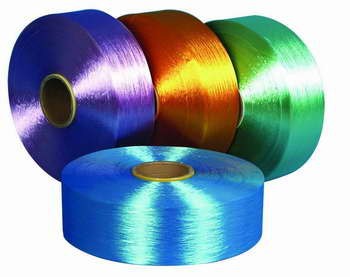
We
at Benlon India are dyeing 110 & 150 denier of polyester yarn in Bright
Sparkle and Semi-Dull. We are the only spinners in India, dyeing the yarn
conventionally & producing dope dyed yarn. We are quality suppliers of
polyester cationic dyed yarn which is used in the saree industry in South India
and Varanasi. Following are the denier range in which we manufacture Polyester Dyed Yarn -
Denier Range
|
Lustre
|
Cross Section
|
Type Conventional
Dyed
|
20/Mono/3 Ply &
5 Ply (Hollow Twisted)
|
Bright
|
Trilobal
|
Flat Yarn
|
110/72/0
|
Bright
|
Cationic
|
Bright Cationic
Dyed Texturised
|
150/72/0
|
Bright
|
Cationic
|
Texturised
|
150/72/0
|
Bright
|
Cationic
|
Bright Air
Texturised
|
75/36/450/2
|
B.S.P.
|
Trilobal
|
Texturised
|
50/36/0
|
B.S.P.
|
Trilobal
|
Texturised
|
75/36/450 1 & 2
Ply
|
B.S.P.
|
Trilobal
|
Flat FDY Yarn
|
50/36/450
|
B.S.P.
|
Trilobal
|
Flat FDY Yarn
|
150/36/450/2
|
B.S.P.
|
Trilobal
|
Flat FDY Yarn
|
150/72 & 200/72
|
B.S.P.
|
Trilobal
|
Texturised
|
Cationic dyeable polyester has become
increasingly popular in recent years as a textile yarn, primarily because
cationic dyes are capable of producing brighter shades than regular (disperse)
dyeable polyester. In practice, the cationic dyeable polyester is frequently combined
with other fibers, such as regular (disperse) dyeable polyester, wool, or
cellulosic yarns, to produce various multicolor or cross-dyed effects. It is
also known to use cationic dyeable polyester in combination with other yarns which are unaffected by cationic dyes to thereby achieve color/white effects.
Cationic dyeable polyester yarn is a special polyester yarn that can be colored with cationic dye, unlike ordinary polyester yarns.
Excellent color development and fastness have enabled cationic-dyeable
polyester yarns to be used in many applications. Conventionally, however, they
must be dyed at high temperature and pressure, making it difficult to combine
them with wool, silk or other natural fibers that tend to lose strength and
texture when subjected to extreme conditions. Combination with polyurethane or
other elastic fiber also has been problematic.
Cationic-dyeable polyester yarns that can be dyed at ambient temperature and pressure exist, but their yarn strength is generally 20-30% below that of ordinary polyester yarns. This weakness complicates their use as differentiated yarns, such as highly multi-filament or non-circular cross-section yarn, so applications and compatible materials are limited.
Cationic-dyeable polyester yarns that can be dyed at ambient temperature and pressure exist, but their yarn strength is generally 20-30% below that of ordinary polyester yarns. This weakness complicates their use as differentiated yarns, such as highly multi-filament or non-circular cross-section yarn, so applications and compatible materials are limited.
If you
are interested in our products and would like to be part of our growth story,
please contact us on sales@benlonindia.com
For more information about our
company and our products, please visit www.benlonindia.com
