Showing posts with label Speciality Yarn manufacturer and exporter. Show all posts

Tuesday, 3 November 2015

FDY - Fully Drawn Yarn

Fully Drawn Yarn
Fully Drawn Yarn (FDY) is produced by spinning the yarn at higher speeds coupled with intermediate drawing integrated in the process itself. This allows stabilization through orientation and crystallization. 
Fully Dawn Yarn is used as weft or weaves. It can also be knitted or woven with any other filament yarn in order to produce different varieties of fabrics such as home furnishing fabrics, fashion fabrics, terry towels etc.
FDY is available in 3 lustres, Semi-dull, Bright having circular section & Triloble Bright having triangular cross-sections. Instead of making the fabric with FDY Raw-white first & then dyeing it, Dope Dyed Fully Drawn Yarn can be used to make the colored fabric directly.

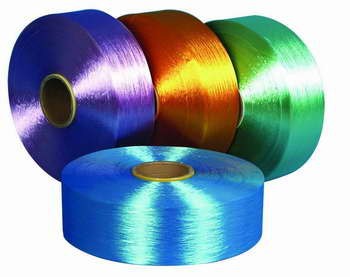
Benlon India Limited is producing fully drawn yarn in more than 400 colors. It is being used in sarees fabric in south of India, Varanasi & Mau and furnishing in Panipat.
Benlon India is also manufacturing double colored FDY in 400 and 800 Dn. We take two different color POY components and draw texturize the same together, which gives a fancy effect in furnishing and bed covers.

Fully Drawn Yarns are produced by a continuous polymerisation process. All critical yarn properties such as tenacity, elongation, Uster variation and boiling water shrinkage are closely monitored and controlled. Controlled interlace enables the yarns to be twisted or sized in subsequent operations.


FDY has the following properties -
   1.       Intermingled FDY yarns are suitable for direct twisting, warping and weaving.      
   2.       The fabric made from these yarns have a feel and drape similar to fabrics. Produced from pure silk resulting in high realization of product quality.
   3.       These yarns eliminate draw-twisting and sizing process reducing the cost of products for light and medium range of fabrics.
   4.       There is high efficiency and low breakages in
   5.       Excellent dyeing consistency.

Normal Partially Oriented Yarn (POY) needs to be necessarily texturised before being used for making fabric whereas FDY is drawn fully during the process of spinning itself and therefore does away with the requirement of texturising and can use directly for making fabric.

FDY is generally used for better quality fabric. As the process of texturising is avoided, FDY yields higher contribution as compared to the normal POY. Fully-drawn yarns are used to manufacture textile fabrics without the need for further finishing. Wherever textiles are to hang smoothly or glide fully-drawn yarns are used.


FDY is used in the following products –
    1.       Flags and banners
    2.       Floatation Devices
    3.       Parachutes
    4.       Team Apparel
    5.       Swimwear
    6.       Intimate Apparel
    7.       Compression Fabrics
    8.       Tents
    9.       Cargo Bags
   10.   Upholstery
   11.   Elastic Bands


Manufacturing Process
The Raw material i.e. PET Chips are dried, melted, filtered and then distributed to spinning manifolds followed by spinning position to get fully drawn yarn. To manufacture FDY, PET chips are fed into dryer where the moisture is reduced from 0.30% to 0.0020%. After this, chips are melted, filtered through polymer filter and extruded through the spinnerets. Extruder is electrically heated microprocessor temperature controlled and screw speed is controlled and monitored very precisely to ensure uniform quality. The extruded filaments are cooled by filtered air in the quench chamber with precise temperature control. Air having no turbulence is used to ensure perfect evenness. High quality antistatic lubricating oil is applied to avoid static charges in the yarn. The yarn is taken through heated godets to maintain residual elongation. Air punching is done at regular intervals by intermingling nozzles and finally wound on automatic winder in the take up. The FDY so made is capable of running in high speed warping, sizing, knitting, circular knitting and looms.

Nylon Fully Drawn Yarn
Nylon POY is used as raw material for manufacturing Nylon FDY. For manufacturing FDY one stage high speed process is used. 
The main use of nylon FDY is for stocking, knitting, weaving fabrics, weaving looms and hoovering machines. Also it can be knitted or woven with any other filament yarn to get fabric of various different varieties. It is mainly used in Home Furnishing Fabrics, Fashion Fabrics, Denim, Terry Towel and fishing nets. Nylon FDY is available in bright, semi dull and full dull FDY.


Spinning Speeds

The type of yarn produced during melt spinning is decided by the spinning speed. Low oriented yarn (LOY) is produced at speeds below 1800 m/min. Medium oriented yarns (MOY) are spun between 1800-2800 m/min. Partially oriented yarn (POY) is spun at speeds between 2800 to 4000 m/min., where the yarn is more oriented with a little crystallinity. This gives POY better stability, and therefore, POY is preferred as commercial intermediate for drawn or textured yarns. High oriented yarn (HOY) is spun at 4000-6000 m/min and fully oriented yarn (FOY) is spun at speeds in excess of 6000 m/min.
For nylon-6, the POY speeds are nearly 4000 – 4200 m/min. Nylon-6 spun at lower speeds undergo post spinning crystallization on conditioning. At speeds near to 4000 m/min, nylon-6 POY is stable and essentially consists of crystals, which are deformable during drawing and texturing. Polypropylene has very high rate of crystallization and the material crystallizes in the spinning line at any speed, unless, it is quenched at a fast rate in cold water.

Spinning of fully drawn yarns (FDY) or high performance fibres
High speed spinning of POY at speeds greater than 6000 m/min produces highly oriented and crystalline yarn which may be categorized as fully drawn yarn (FDY). These may be used directly without further drawing, though their properties are inferior to fully drawn yarn obtained by two step process of spinning and drawing. Very high spinning speeds are required to increase the drag force on the spinning filament which in turn increases the stress level in the filament so that polymer chains get oriented and stabilized by stress induced crystallization.

FDY Spinning & Drawing Machine at Benlon India

Benlon India is a quality producer of Fully Drawn Yarn and has latest spinning and drawing machines at its plants. The machines have the following features –
  •       Our machines have new type of energy conserving spin beams with 25% less energy consumption compared with conventional ones. 
  •            The machines have bottom mounted spin packs bettering evenness of melt flow and the uniformity of spinneret surface temperature and reducing labour as well.
  •        New type of quenching system provides smoother air blowing for the better yarn evenness. 
  •       The heated godet with thermal tube technology results in more even surface temperature and less energy consumption.
  •       Lastly, fully automatic winders with precision winding, maximum 24 packages, leads to higher successful changer-over rate and good package formation.


If you are interested in our products and would like to be part of our growth story, please contact us on sales@benlonindia.com 
For more information about our company and our products, please visit www.benlonindia.com 


Tuesday, 20 October 2015

Polyester Cationic Dyed Yarns

Polyester Cationic Dyed Yarns

Polyester Cationic Dyed Yarn is produced from CDP chip that consists of dimethyl isophthalate with polar radical SO3Na.The dye-absorption property of fiber is greatly improved. It is thus easy to be dyed with improved dye-absorption rate and moisture-absorption property. Cationic Dyed Yarns have features like light and water color fastness, vivid color and luster, good deep dyeing property, high dye-absorption rate, good stability in high temperature dyeing solutions and high stability of dyes when the PH value changes in dyeing bath.

The special properties of a cationic dyed polyester yarn are –
  •      Cost effective dyeing procedure using intensive cationic dyes and low dyeing temperatures from 980 to 1200C
  •      Excellent bath exhaustion
  •      High dyeing speed
  •     Cationic yarns can also be colored using disperse dyes up to 1200C
  •     Ideal mixing element for wool or elasthane fibres (Lycra) that cannot be dyed at high temperatures
  •     Offers good combination possibilities with other fibers – mixing element for dual-tone and multi-color effects
  •     Shows high luminosity when using cationic dyes
  •     Excellent resistance to wet and sublimation
  •     Low pilling
  •     Problem-free recycling with normal polyester


Polyester Cationic Dyed Yarns have certain advantages over other dye yarns. They are as follows-   
·         high dyeing power leads to low dyeing costs
·         shades are obtained rapidly and so shorter dyeing times
·         complete dyeing setting means no subsequent reductive cleaning
·         no soiling of Lycra leads to excellent resistance to wet and sublimation
·         luminous tones possible gives various fashion shades
·         PES and PES cat mixtures makes creation of dual-tone effects possible
·         Higher dyeing temperature means shorter dyeing time

Often used to achieve cross dyed effects, Cationic dyed yarn is woven in a pattern with regular yarn in the same fabric. The pattern becomes visible by dyeing the fabric in 2 baths, one for each of the types of yarn.


We at Benlon India are dyeing 110 & 150 denier of polyester yarn in Bright Sparkle and Semi-Dull. We are the only spinners in India, dyeing the yarn conventionally & producing dope dyed yarn. We are quality suppliers of polyester cationic dyed yarn which is used in the saree industry in South India and Varanasi. Following are the denier range in which we manufacture Polyester Dyed Yarn -

Denier Range
Lustre
Cross Section
Type Conventional Dyed
20/Mono/3 Ply & 5 Ply (Hollow Twisted)
Bright
Trilobal
Flat Yarn
110/72/0
Bright
Cationic
Bright Cationic Dyed Texturised
150/72/0
Bright
Cationic
Texturised
150/72/0
Bright
Cationic
Bright Air Texturised
75/36/450/2
B.S.P.
Trilobal
Texturised
50/36/0
B.S.P.
Trilobal
Texturised
75/36/450 1 & 2 Ply
B.S.P.
Trilobal
Flat FDY Yarn
50/36/450
B.S.P.
Trilobal
Flat FDY Yarn
150/36/450/2
B.S.P.
Trilobal
Flat FDY Yarn
150/72 & 200/72
B.S.P.
Trilobal
Texturised


Cationic dyeable polyester has become increasingly popular in recent years as a textile yarn, primarily because cationic dyes are capable of producing brighter shades than regular (disperse) dyeable polyester. In practice, the cationic dyeable polyester is frequently combined with other fibers, such as regular (disperse) dyeable polyester, wool, or cellulosic yarns, to produce various multicolor or cross-dyed effects. It is also known to use cationic dyeable polyester in combination with other yarns which are unaffected by cationic dyes to thereby achieve color/white effects.
Cationic dyeable polyester yarn is a special polyester yarn that can be colored with cationic dye, unlike ordinary polyester yarns. Excellent color development and fastness have enabled cationic-dyeable polyester yarns to be used in many applications. Conventionally, however, they must be dyed at high temperature and pressure, making it difficult to combine them with wool, silk or other natural fibers that tend to lose strength and texture when subjected to extreme conditions. Combination with polyurethane or other elastic fiber also has been problematic.

Cationic-dyeable polyester yarns that can be dyed at ambient temperature and pressure exist, but their yarn strength is generally 20-30% below that of ordinary polyester yarns. This weakness complicates their use as differentiated yarns, such as highly multi-filament or non-circular cross-section yarn, so applications and compatible materials are limited.
If you are interested in our products and would like to be part of our growth story, please contact us on sales@benlonindia.com 
For more information about our company and our products, please visit www.benlonindia.com 

Sunday, 18 October 2015

Nylon 6 and Nylon 66 Yarn

Nylon
Nylon was the first truly synthetic fiber to be commercialized. Nylon was developed in the 1930s by scientists at Du Pont, headed by an American chemist Wallace Hume Caruthers. It is a polyamide fiber, derived from a diamine and a dicarboxylic acid, because a variety of diamines and dicarboxylic acids can be produced, there are a very large number of polyamide materials available to produce nylon fibers.
The two most common versions are nylon 66 (polyhexamethylene adiamide) and nylon 6 (Polycaprolactam, a cyclic nylon intermediate). Nylon 66 has been preferred in North American markets, whereas nylon 6 is much more popular in Europe and elsewhere.
The amide group (-CO-NH-) provides hydrogen bonding between polyamide chains, giving nylon high strength at elevated temperatures, toughness at low temperatures, combined with its other properties, such as stiffness, wear and abrasion resistance, low friction coefficient and good chemical resistance. These properties have made nylons the strongest of all man-made fibers in common use. Because nylons offer good mechanical and thermal properties, they are also a very important engineering thermoplastic. 

Physical and Chemical Properties Nylon Fabrics

Strength: Nylon has good tenacity and the strength is not lost with age. Nylon has a high strength to weight ratio. It is one of the lightest and strongest textile fibres. It is one of the fibres which are added at the points of wear such as knees of jeans and toes and heels of socks. Nylon has excellent abrasion resistance.

Elasticity: Nylon has good elasticity which makes it much suitable for the apparel purposes. Because of this excellent elasticity property, the nylon materials return to their original length and shreds the wrinkles or creases. However, if stretched too much, it will not completely recover its shape. The high elongation and excellent elastic recovery of nylon contributes to the outstanding performance in hosiery. Nylon hosiery recovers to its original shape at knees and ankles instead of bagging.

Resilience: Nylon fabrics have excellent resilience. Nylon fabrics retain their smooth appearance and wrinkles from day-to-day daily activities can be removed easily.

Drapability: Fabrics of nylon filament yarn have excellent draping qualities. The drape of the fabrics made from nylon can be varied depending on the yarn size. The light weight sheer fabrics of nylon night gowns have high-draping quality. The medium-weight dress fabrics can drape very nicely.

Heat Conductivity: The heat conductivity of the nylon fabrics vary depending upon the fabric construction, the type of nylon (staple/filament) used in the construction etc. For instance, the filament nylon used in the open construction would be cooler when compared to the same filament used in a closed construction.

Absorbency: Nylon fabrics have low absorbency. The low absorbency of the fabrics tends to be advantageous and also disadvantageous. The main advantage of the nylons low absorbency is that the water remains on the surface of the fabrics and runs off the smooth fabric and hence dries quickly. This property makes the nylon fabrics suitable for raincoats and shower curtains. Nylon’s low absorbency has a disadvantage in that the fabric feels clammy and uncomfortable in warm, humid weather.

Cleanliness and Washability: Nylon fabrics are easy care garments. Nylon fabrics are smooth, non-absorbent and dry quickly. Dirt doesn’t cling to this smooth fibre, which can be washed easily or can be even cleaned by using a damp cloth.

Effect of Bleaches: The nylon fabrics are white and generally do not require bleaching. The nylon fabrics which pick up colour or develop greying should be bleached with oxidising bleaches such as hydrogen peroxide.

Shrinkage: Nylon fabrics retain their shape and appearance after washing. It has good stability and does not shrink.

Effect of Heat: Nylon should always be ironed at low temperatures. Using hot iron will result in glazing and then melting of the fabric.

Effect of Light: Nylon fabrics have low resistance to sun light. They are not suitable for curtains or draperies as it is weakened by the exposure to sun light.

Resistance to Insects: Nylon is resistance to the moths and fungi. 

Reaction to Alkalis: Nylon has excellent resistance to alkali's but the frequent and prolonged exposures to alkalis will weaken the nylon fabrics. 

Reaction to Acids: Nylon is less resilient to the action of acids and is damaged by strong acids.

Affinity for Dyes: Nylon can be easily dyed with a wider range of dyes. The dyed fabrics retain their colour and have good resistance to fading.

Resistance to Perspiration: Nylon fabrics are resistant to perspiration.


Nylon 66 Yarn

Features:
Nylon 66 filament yarn is good for clothing use on weaving and circular knitting and fancy yarn process. Fabric made of Nylon 66 has following superior features:
ü  
   More toughness due to higher yarn modulus.
ü  Softer and better drapery.
ü  No crinkle due to good elasticity recovery.
ü  Less possible to be crispy due to cold weather resistance.
ü  Stable measurement due to higher strength.
ü  Higher abrasion resistance.
ü  Less yellowish and brighter color due to more heat resistance.
ü  Good sweat absorption and ventilation, easy wash and quick dry.

Application:
underwear, lingerie, pantyhose, fashion apparel, fitness wears, sportswear, beach shorts, casual jackets


Nylon 6 Yarn

Nylon 6 yarn is available in 5 different types
·         High Oriented Nylon Yarn (HOY)  
Nylon 6 filament yarn HOY is brighter and softer. It's good for clothing and industrial use on weaving, circular knitting, warp knitting and process of fancy yarn.

·         Fully Drawn Nylon Yan (FDY)
Nylon 6 filament yarn FDY is good for clothing and industrial use on weaving, circular knitting, and warp knitting.

·         Partially Oriented Nylon Yarn (POY)
Nylon 6 filament yarn POY is for the purpose to texturize DTY.

·         Draw Textured Nylon Yarn (DTY)
Nylon Textured Yarn is also known as Nylon 6 filament yarn DTY. It is good for clothing use on circular knitting and warp knitting and process of covering yarn, dyeing yarn, and fancy yarn.

·         Air textured Nylon Yarn (ATY)
Owing to hairy feeling like natural cotton, ATY is also called cotton-like yarn. Nylon Filament ATY is light weight, wear resistant, easily cleaned and quick dry. It is suitable for sports wears, casual wears and jackets.

The main difference between nylon 6 and nylon 6.6 is that nylon 6 has a much lower melting point than nylon 66. This is a serious disadvantage, as garments made from it must be ironed with considerable care.


General Nylon Fiber Care Tips
    • Most items made from nylon can be machine washed and tumble dried at low temperatures. Use warm water and add a fabric softener to the final rinse cycle.
    • Remove articles from dryer as soon as tumbling cycle is completed.
    • If ironing is required, use warm iron. 


Nylon 6 Yarn produced by Benlon India has superior resistance to light degradation. Also nylon 6 yarn has advantage over nylon 6.6 in respect of dyeability, elastic recovery, and thermal stability and thus, is used for textile and carpet manufacture.
Benlon India Ltd. is supplying Conventional Dyed Nylon Yarn mainly to the manufacturers of Hosiery Goods. It is an expensive yarn and bought by manufacturers manufacturing very high quality products. We also supply tailor made yarn to the manufactures. This yarn is used in socks, name tapes and sportswear.


Denier Range
Lustre
Cross Section
Type Conventional Dyed
102/24/1
S.D.
Round
Crimped
102/24/2
S.D.
Round
Crimped
70/24/1
S.D.
Round
Crimped
102/24/2
S.D.
Round
Crimped
140/72/1
S.D.
Round
Crimped
44/14/1
S.D.
Round
Crimped

If you are interested in our Nylon 6 Crimp Dyed Yarn and products and would like to be part of our growth story, please contact us on sales@benlonindia.com 

For more information about our company and our products, please visit www.benlonindia.com